

This page summarises Regulation (EU) 2025/40 and the European Commission’s FAQ and describes how Polygon One works with them. It is not legal advice. The Commission FAQ is interpretive guidance and binds neither national authorities nor courts. Check your specific case with your legal counsel.
Overview
On every packaging unit’s detail page, Polygon One shows an obligation checklist: the list of PPWR duties that apply to exactly this unit. The list is derived automatically from the economic-operator role and the unit’s properties — you never maintain a checklist by hand. Above the checklist you see the context: “These duties follow from this unit’s role”. Duties that do not apply to the role simply never appear — the checklist only shows what actually concerns you.Not in this checklist. The checklist covers the duties Polygon One derives and tracks per packaging unit — it is not an exhaustive list of all PPWR duties. Duties to watch outside the platform include:
- Compostability (Art. 9) — from 12 Feb 2028, e.g. for permeable tea and coffee bags.
- Design of reusable packaging (Art. 11) — already applies since the PPWR entered into force on 11 Feb 2025; the minimum number of rotations follows from an implementing act (due by 12 Feb 2027).
- Environmental claims (Art. 14) — claims about properties the PPWR regulates are only allowed where you exceed the minimum requirements.
- Empty space (Art. 24) — at most a 50% empty-space ratio for grouped, transport, and e-commerce packaging; for sales packaging there is no fixed threshold, minimisation under Art. 10 applies instead.
- Format bans (Art. 25, Annex V) — bans on certain single-use formats from 1 Jan 2030.
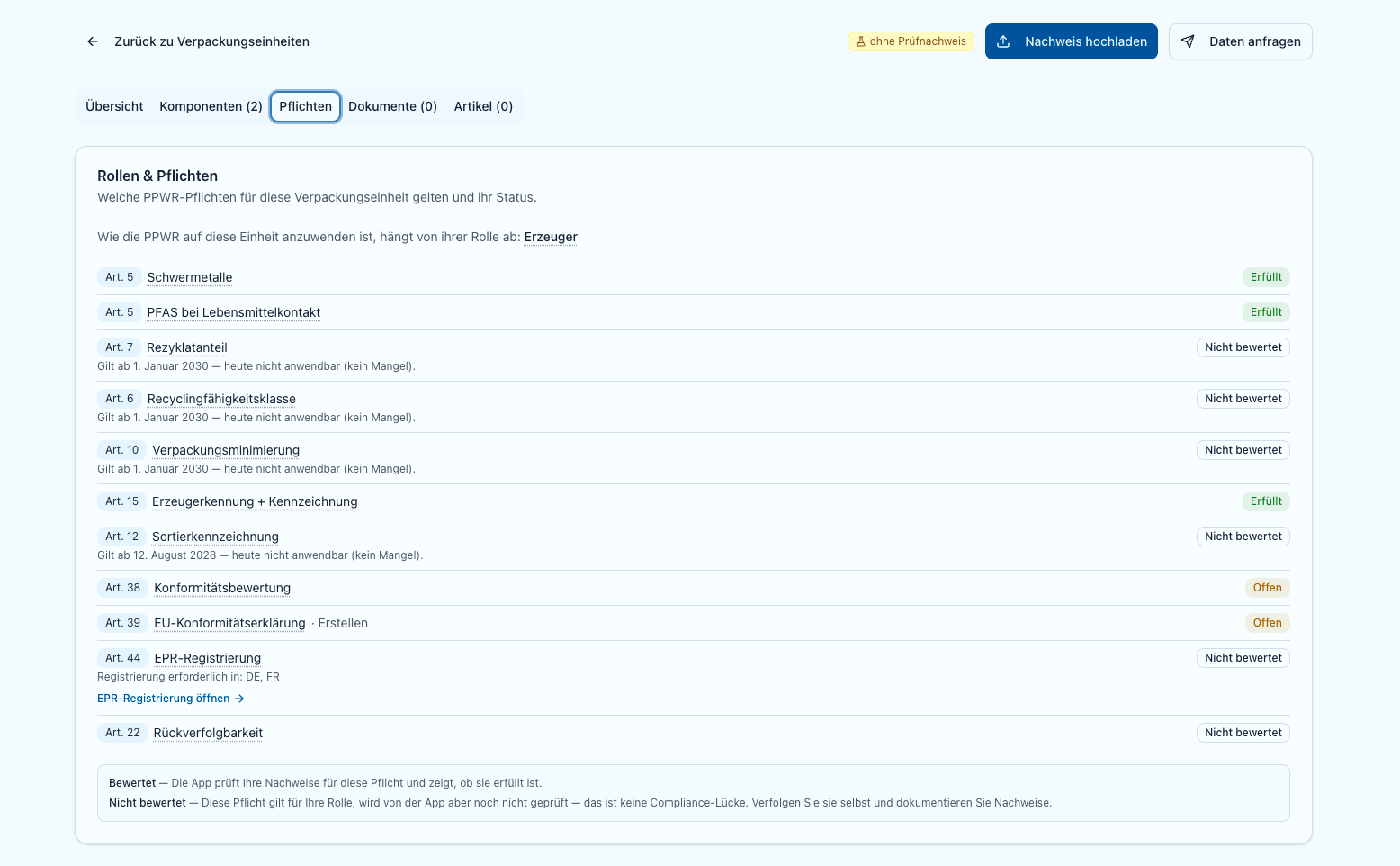
Obligation checklist on the detail page of a packaging unit
Which duties exist
Every row carries a badge with the relevant PPWR article and a plain-language explainer. The possible duties:Marking: batch level, not individual items
Traceability under Art. 15(5) works at type, batch, or serial level, not at the level of the individual item. Concretely:- No per-item serialisation. A type, batch, or serial number is enough, and it may refer to a packaging type or a production batch. Commonly used standardised items such as adhesive tapes, generic plastic bags, or desiccant bags are normally traceable at production-batch level.
- One component is enough. For a unit made up of several components, the information on one of them suffices — for a yoghurt cup, on the cup itself, not additionally on the lid and sleeve.
- Accompanying document as the fallback. Where the size or nature of the packaging does not allow the information to be affixed, it may be provided in a document accompanying the packaging. Whether affixing is possible is assessed case by case, taking into account the physical dimensions, shape, and functional characteristics.
- Manufacturer details. Required are the name (or registered trade name or registered trademark), the postal address, and, where available, the electronic means of communication of the manufacturer (Art. 15(6)).
The statuses
Every duty in the checklist has exactly one of three statuses:Honesty rule: Duties with a 2028 effective date (sorting label) or 2030 (recycled content, recyclability grade, packaging minimisation) are shown as Not yet in force with the note “Applies from {date} — not applicable today (not a deficiency)”. A future duty is never counted as an open gap. The duties tied to the general application date of 12 August 2026, in contrast, already apply and are treated as actionable. The legal basis is Art. 71 of Regulation (EU) 2025/40.
Assessed vs. Not assessed
In addition to the status, every duty carries a coverage marker:- Assessed — the app checks your evidence for this duty and shows whether it is met (heavy metals, PFAS, marking, conformity assessment, EU Declaration of Conformity — the latter neutral/informational for distributors).
- Not assessed — the duty applies to your role, but the app does not yet verify it. This is not a compliance gap: track it yourself and keep evidence in your records (e.g. traceability, packaging minimisation).
Declaration of Conformity: generate or collect — depending on the role
The EU Declaration of Conformity duty carries a different task label depending on the role:Declaration of Conformity
How to generate the declaration from your data or verify collected declarations.
Unit-level status and dashboard rollup
From the obligation checklist, the app derives an overall status per unit that you will find again in the units table, at article level, and in the dashboard:
Important: only assessed and already-in-force duties feed the overall status. “Not yet in force” and “Not assessed” duties can never pull the status to Action needed — so the rollup never contradicts the checklist on the detail page.
The KPI tile on the units overview counts your units by exactly these three values; at article level, the worst status of all linked units applies (Action needed dominates).
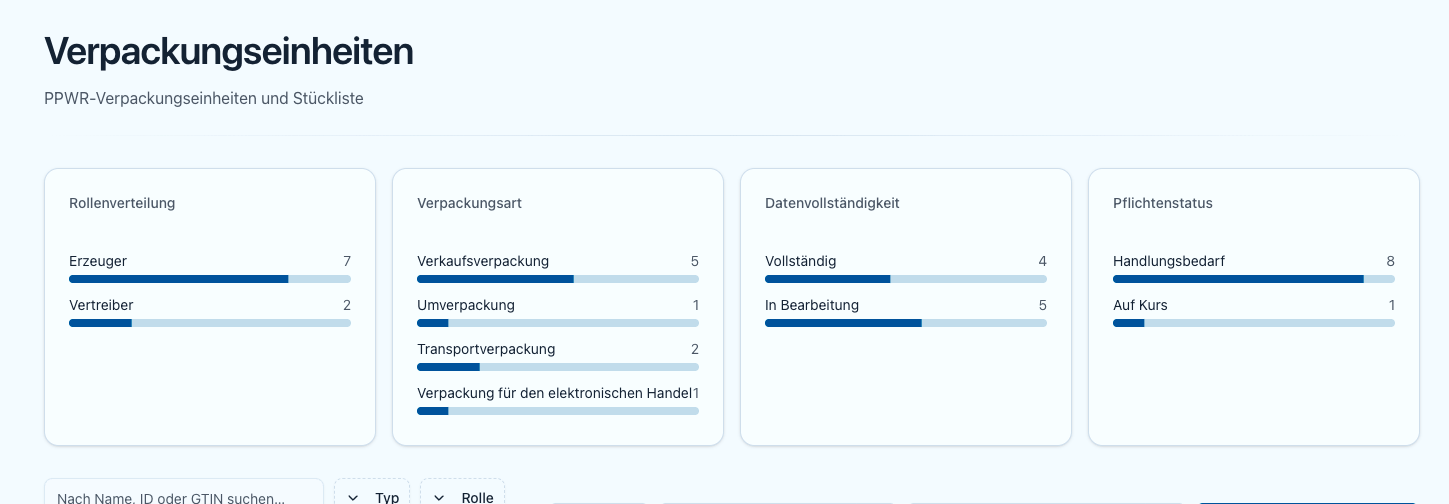
KPI distribution of units by overall status
Next steps
Data collection
Close outstanding duties: collect data and evidence from suppliers.
Evidence documents
Upload test reports and technical documentation — the AI reads out the values.
Transition & enforcement
What happens to existing stock, and how enforcement works since 12 Aug 2026.