

This page summarises Regulation (EU) 2025/40 and the European Commission’s FAQ and describes how Polygon One works with them. It is not legal advice. The Commission FAQ is interpretive guidance and binds neither national authorities nor courts. Check your specific case with your legal counsel.
Overview
A component is a single packaging material and carries the data that matters for Art. 5. It is reusable: the same component can be part of several packaging units. You manage components under sidebar → Components (/packaging/components); create a new one via New component — in the catalogue, from a unit’s bill of materials, or via import.
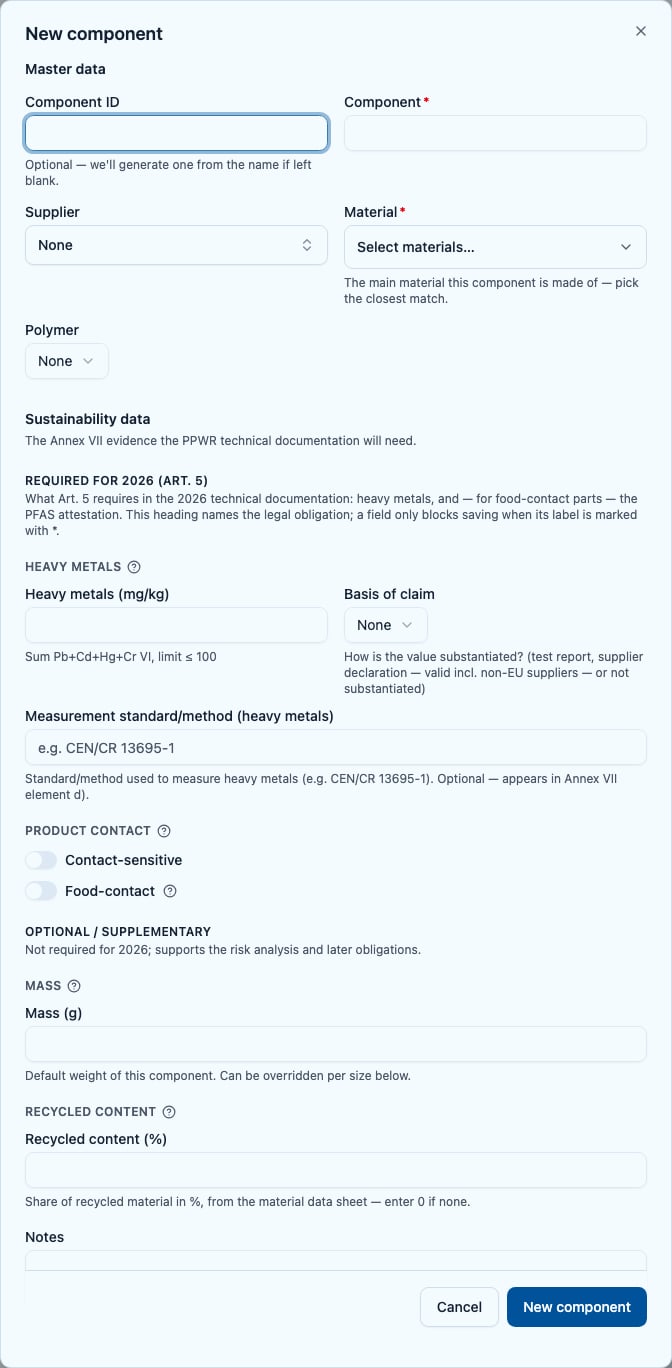
The component form with master data and sustainability data
”Master data” section
The labels above are the choices in the form. For the import you put the code in parentheses into the file instead (e.g.
paper_board); the full value list for every coded column is on the import page.”Sustainability data” section
This section provides the evidence the technical documentation per Annex VII needs. It is split into Required for 2026 (Art. 5) and Optional / supplementary.Required for 2026 (Art. 5)
Heavy metals
- Heavy metals (mg/kg) — the sum of lead, cadmium, mercury and hexavalent chromium. Art. 5 limits it to 100 mg/kg for all packaging. The field gives instant feedback:
- ✓ Within limit (≤ 100 mg/kg)
- ⚠ Exceeds limit (> 100 mg/kg)
- Basis of claim — how the value is evidenced: test report or supplier declaration (also valid from suppliers outside the EU). With “test report”, the report must be uploaded as a file on the supplier collection flow.
- Measurement standard/method (heavy metals) — the applied standard/method (e.g.
CEN/CR 13695-1), appears in Annex VII point (d).
The limit binds the packaging unit as a whole — including the associated inks, varnishes, glues and adhesives placed on the market by the manufacturer (Commission FAQ III.17 on the Art. 5 substance restrictions). So capture those parts too where they belong to the unit.
Recycled-glass derogation — talk to us. Commission Decision 2001/171/EC continues to apply: exceeding 100 ppm is lawful where the exceedance is due to the addition of recycled glass; intentional introduction of lead, cadmium, mercury or hexavalent chromium remains prohibited (FAQ III.14). Polygon One today flags every value above 100 mg/kg as an exceedance and allows no derogation — capturing a derogation attestation is in preparation. Until then, please get in touch with us.
Product contact and PFAS
Two switches control the PFAS block:- Contact-sensitive
- Food-contact — unlocks the PFAS fields (food contact implies “contact-sensitive”). Disabling the switch discards the PFAS entries again.
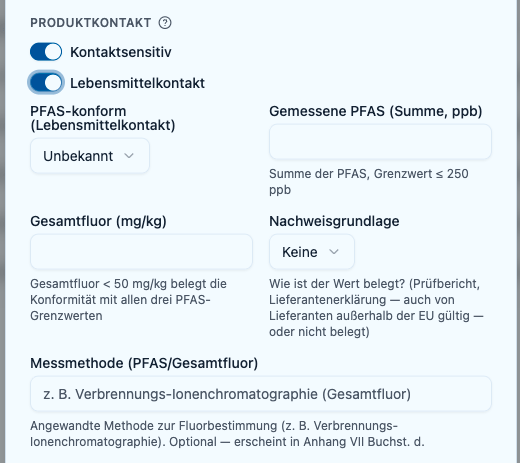
The PFAS fields unlocked when food contact is enabled
How to read the PFAS values:
- The limits apply equally to intentionally added and unintentionally present PFAS — Art. 5(5) does not distinguish between them (Commission FAQ III.16).
- A CAS list of the PFAS concerned will not be published; the limits apply to all substances falling under the PPWR definition (FAQ III.18).
- A harmonised testing methodology is still being developed — the Commission is working with the market surveillance authorities and the EURL for food contact materials on a harmonised testing protocol (FAQ III.19).
Optional / supplementary
These fields are not required for 2026; they support the risk analysis and later obligations and never block completeness.- Mass (g) — the basis for the material breakdown per Annex VII and for packaging minimisation (Art. 10, from 2030).
- Recycled content (%) — post-consumer recyclate for plastic parts. A value above 0% requires a source (post-consumer/PCR or post-industrial/PIR) and a method (physical or mass balance). For plastic, the field shows an informational target comparison.
- Notes and, optionally, a technical drawing (Annex VII point (b)).
Which target applies
There is no single quota. The minimum under Art. 7(1) follows from two steps — first contact sensitivity, then polymer (Commission FAQ V.5):
Plus the boundary conditions:
- Scope: the targets apply to the plastic parts of sales, grouped and transport packaging (FAQ V.5).
- Single-use beverage bottles: the 10% target under point (b) does not cover single-use plastic beverage bottles — point (c) applies to them (FAQ V.5).
- De-minimis: plastic parts representing less than 5% of the total weight of the packaging unit are exempt (Art. 7(5)(b); FAQ V.7). The exemption applies to plastic parts only — a metallic closure is out of scope anyway.
- Not deemed plastic: adhesives, paints and inks — regardless of their share of the weight (FAQ V.3).
- Calculation: as an average per manufacturing plant and year, for each packaging type and format (FAQ V.2).
- Deadline: 1 January 2030 or three years after entry into force of the implementing act under Art. 7(8) — whichever is later (FAQ V.6).
Data completeness
A component’s Data completeness badge is Complete exactly when the heavy-metal value is present and — for food contact — a PFAS attestation (a confirmation or a total-fluorine measurement). Partly filled → In progress, nothing filled → Incomplete. Recycled content and mass deliberately do not count.When an Art. 5 substance is claimed (a value entered), both the basis of claim and the measurement standard/method become required. The form blocks saving until a substantiated basis is provided.
Reuse across units
On a component’s detail page, the Packaging units tab shows all units the component is part of — each with the linked quantity. Because the data lives centrally on the component, a change takes effect for all linked units.Deleting, trash, and permanent deletion
Deleting is reversible at first: “Delete this component? It moves to the trash, where you can restore it.” How the trash, restoring and permanent deletion work in detail — including the block from a declaration of conformity and the separate Permanently delete packaging right — is described under packaging units. The same applies to evidence documents. What is specific to components. A deleted component does not block its code — it can be reassigned immediately. If the code has been reassigned by the time you restore, the restore fails (the message names the component that now holds it); in a bulk restore only those rows are skipped and counted in the result. The restore dialog names the limits: “The component and its documents are restored. Note: cancelled data requests stay cancelled, and superseded AI proposals are not reinstated.”If a component is not permanently deleted, it stays in the trash until the PPWR retention period has elapsed. For components that is always 10 years: a component carries no reusability signal of its own, so the longer period is applied throughout. Restoring resets that clock.
Back to the data model
How components, units and articles relate.