

This page summarises Regulation (EU) 2025/40 and the European Commission’s FAQ and describes how Polygon One works with them. It is not legal advice. The Commission FAQ is interpretive guidance and binds neither national authorities nor courts. Check your specific case with your legal counsel.
Welcome to the PPWR module
The PPWR module of Polygon One helps you make your packaging conform to the Packaging Regulation — Regulation (EU) 2025/40 (PPWR) and to evidence that conformity. The regulation is directly applicable law in all Member States; the general date of application is 12 August 2026. From that date, packaging must, among other things, meet the substance restrictions of Art. 5 (heavy metals summing to ≤ 100 mg/kg, PFAS limits for food-contact packaging), pass a Module A conformity assessment (self-assessment, no notified body), have technical documentation per Annex VII, and be accompanied by an EU Declaration of Conformity per Annex VIII.Polygon One does not perform a conformity assessment on your behalf and does not issue a legal verdict. The platform captures the required data in a structured way, shows what is still missing, and generates the documents from it — responsibility for issuing and for the content stays with the respective economic operator.
Why the data lives with the suppliers
The data that matters for Art. 5 — material composition, heavy-metal values, PFAS evidence, recycled content — relates to the individual components of a packaging. Usually the operator placing the packaging on the market does not hold this data; the material or packaging supplier does. That is why collecting data from suppliers is a core part of the process: you capture the structure of your packaging (packaging units and components) and request the missing evidence specifically from the responsible suppliers. The completeness of this component data determines when a packaging unit is ready for its Declaration of Conformity.The conformity process
The flow in Polygon One follows four stages — from building the master data to the finished Declaration of Conformity:Stage 1: Master data
Create your articles, packaging units and components and link them into a bill of materials. The packaging unit is the subject of the Declaration of Conformity.
Build master data
The data model: articles → packaging units → components.
Stage 2: Roles & obligations
Determine your economic-operator role per packaging unit (manufacturer, importer, distributor …). The role decides which obligations apply and who issues the Declaration of Conformity.
Roles & obligations
Which role triggers which PPWR obligations.
Stage 3: Data collection
Capture the component data and request missing evidence from your suppliers. Uploaded documents are analyzed by AI and values are proposed.
Data collection
Request from suppliers, gather evidence, review AI proposals.
Stage 4: Documentation
Generate the technical documentation (Annex VII) and the EU Declaration of Conformity (Annex VIII) — per packaging unit, individually or as a bulk action.
Documentation
Declaration of Conformity and technical documentation.
Digital packaging record
Provide the documents and the Art. 15(6) manufacturer details through a QR code.
Switching between EUDR and PPWR
If your company uses both the EUDR and the PPWR module, a module switcher appears at the top of the sidebar. Use it to switch between EUDR (deforestation) and PPWR (packaging); after switching you land directly in the dashboard of the chosen module. The switcher is only shown when more than one module is enabled for your company.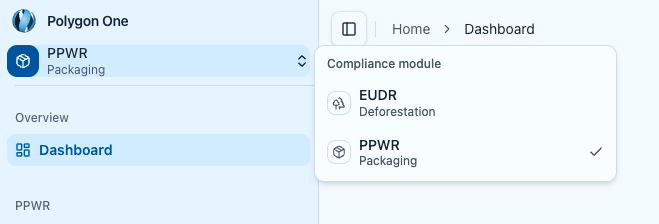
Module switcher in the sidebar — switching between EUDR and PPWR
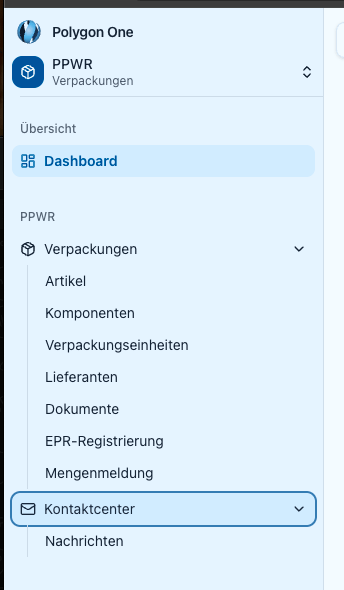
Sidebar with the PPWR module active
What is not yet included
So you can interpret the results correctly:- Recyclability grade: the regulation defines grades A/B/C; the assessment methodology, however, only arrives via delegated acts (expected 2028). The grades become binding in 2030 (or later, depending on the act) — more precisely 24 months after entry into force of the delegated act on recyclability, i.e. 1 January 2030 if the act is adopted in early 2028 as expected (Commission FAQ X.2). Polygon One only stores a declared grade (A, B, C or “non-recyclable”) — there is no automatic assessment.
- Recycled content: the minimum quotas under Art. 7 apply from 2030 (or later, depending on the act) — more precisely from 1 January 2030 or three years after entry into force of the implementing act under Art. 7(8), whichever is later (Commission FAQ V.6, X.2). The app captures the values and shows an informational target hint, but no verdict.
- EPR registration: there is no government API. Registration happens in the respective government portal (in Germany: LUCID/ZSVR). Polygon One guides you through the process, prepares data, tracks the status, and exports the XML file for the volume report.
Continue to the PPWR dashboard
Progress, next steps and the compliance funnel at a glance.